Record expenditure Forecast To Go for different stages for monitoring and corrective action purposes.
To enable the recording of forecasts for different stages, navigate to Configuration Data > Progress Tab. Under the Forecast section, you will see a dropdown from which you can select the stage from which forecasts should be available for initiatives.
Once the Business Case for an initiative has been approved, it is transitioned into the project stage and a Project ID assigned. Once a project ID has been assigned, forecasts to go can be submitted. Forecasts can be updated in Stratex Online via automated API interface, or manually recorded as explained here.
The uploading of forecasts can be restricted to admins only by enabling the checkbox.
Key Concepts
Updating actuals and forecast costs in Stratex Online allows for effective analysis of planned, budgeted, actual and forecast expenditure in order to take mitigating action where variances are observed.
Forecasts can only be updated for an Initiative from the Proposal Stage, Business Case Stage, or Project Stage, depending on the admin's configuration.
Forecasts can be manually entered, uploaded via spreadsheet or integrated from a source system.
Forecasts are recorded for both CapEx and OpEx classifications.
Forecasts can be updated in the local currency of the legal entity assigned to the Benefiting Area of the initiative or the group currency.
Administrators can control which months are open for update. Once all forecasts are updated, the administrator can close the current financial period.
Actual Costs are combined with Forecasts to Go to produce an expenditure Forecast.
If a higher-level area is selected from the org structure, enabling ‘Include Subordinates’ will make initiatives in the lower areas visible.
Users can filter initiative by entering an Initiative ID or Project ID in the search box to view forecasts for a specific initiative.
Users can change forecast versions by selecting the desired version from the date picker in the Forecast From field. This functionality can be restricted through admin configuration.
Saving the forecast rolls forward prior-period forecasts versions and includes them as-is in the current periods forecast version.
Users can toggle the Totalling Type to view Overall or Current FY totals for Actuals, Forecast to Go, Forecast, Planning, and Budgeted.
To view or enter forecasts in a different template, select the template by clicking the Settings icon and choosing the desired option.
Users can view initiatives associated with a Company Code by selecting the desired company.
The forecasting rows are highlighted in different colors:
Grey: This row represents a current forecast, meaning a forecast has been saved for the selected forecast version.
Blue: This row represents a brought-forward forecast, meaning a forecast was entered in a prior version and is now populated in the current forecast version.
Yellow: This row contains a roll-forward amount. You can edit this value by updating the Roll Forward column.
Pink: This row represents a missing forecast, meaning no forecasts have been entered in either previous versions or the current version for the open periods.
“Pre-populate from Plan”: When clicked, this button populates the FTG for initiatives that do not yet have an FTG for the current version. The FTG is populated using the initiative’s planned value.
This action should only ever write to Forecast To Go, it should not not create, change, or populate Actuals.
If an initiative has FTG entered for periods beyond those available in the template, the excess will be summed at the end of the template in a non-editable column.
Instructions
Follow the Manage>Progress>Forecast menu path.
Select your focus Area, and a list of Initiatives in the Project Stage that you are authorized to access is displayed, with 2 rows for CapEx and OpEx costs splits. A subtotal is automatically calculated for each Initiative.
Forecasts to go are maintained by Fiscal Year. Select the relevant fiscal year for forecast maintenance.
The following informational columns are displayed per initiative:
Capex/Opex
Project ID (if applicable)
Currency (the currency of the initiative)
Actual (Cost To Date for the Year)
Forecast To Go (the best estimate of future costs for the year)
Forecast (the sum of Actual and Forecast To Go)
Plan (the latest estimate of the initiative cost)
Approved (the total amount that was approved in the business case submission)
Budget (the amount that was allocated during the portfolio planning and approval process)
Update forecasts to go in the columns corresponding to the months the costs are expect to be incurred.
If required, click Export button to generate an Excel version of the Forecast entry template.
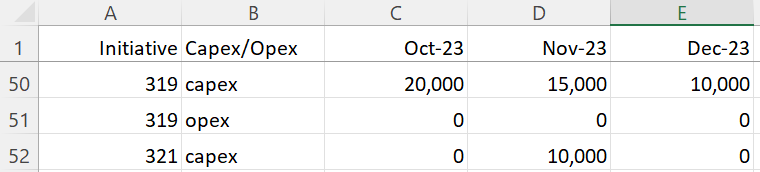
Update forecast by Initiative ID, CapEx/OpEx, and Month (column) in the spreadsheet, and click Upload in Stratex to update actual accordingly.
Once the projects have been updated, click Save.
You can filter the list of initiatives based on whether the selected area is the benefiting area or the sponsoring area, by toggling between the two options.
Users can filter to view only CapEx lines, OpEx lines, or both by selecting the desired options from the dropdown below the Area dropdown.
You can filter the list of initiatives by their stage using the filter option in the header of the Stage column.
In the exported Excel template, users can insert additional columns as needed, provided the column headers follow the MMM-YY format.
Depending on the admin configuration, actuals may or may not be included in forecast calculations.
If enabled, users can select the period for which they enter forecasts by choosing from the available periods in the ‘Forecast From’ month selection.
For example, the forecast to go spreadsheet may be prepared as follows:
Note: Pre-populate from Plan affects Forecast To Go only. Actuals are sourced solely from manual entry on the Actuals screen, spreadsheet upload or source-system integration, and are never generated by pre-populating from plan.